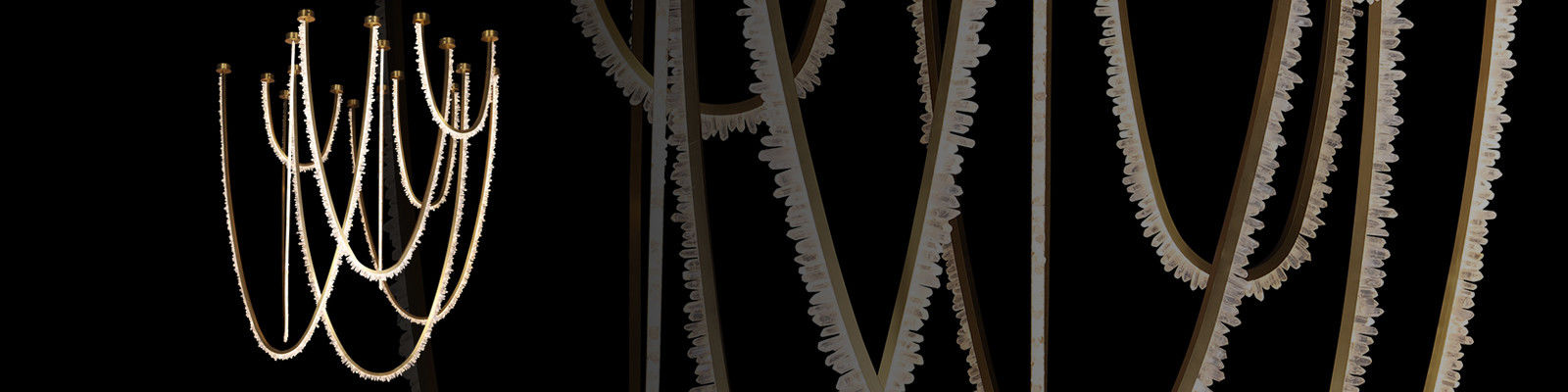
In modern interior architecture, lighting fixtures have evolved from mere functional elements to becoming "visual
anchors" within spatial compositions. When entering a high-ceilinged living room or facing an extra-long dining
table, why do mass-produced lighting fixtures often appear incongruous? This dissonance fundamentally stems from
a "mismatch" between spatial geometry parameters and the physical attributes of lighting fixtures.
Chapter 1: Spatial Geometry and Lighting Proportion Logic
1.1 Mathematical Models for Spatial Volume and Scale Matching
The diameter and hanging height of a chandelier should never be determined arbitrarily. In parametric design, we
introduce the concept of "spatial occupancy ratio." For high-ceiling spaces, the vertical extension of lighting
fixtures directly determines the spatial depth perception. When the ratio between ceiling height (H) and fixture
suspension length (L) becomes disproportionate, it creates "visual discontinuity."
1.2 Physical Properties of Light and Material Refraction
Lighting effects serve as "emotional variables" in spatial ambiance. Different materials exhibit distinct
coefficients for light refraction and diffusion (Albedo). Wood surfaces with high roughness create warm diffused
light, while metals and glass produce high reflectivity that alters spatial light distribution.
1.3 Functional vs. Decorative Weight Distribution
Lighting configurations require differentiated treatment based on spatial function. A weighted scoring model
demonstrates this principle:
-
Game rooms/bars: Focus lighting weight at 0.8, ambient lighting at 0.2
-
Living rooms: Ambient lighting weight at 0.7, focus lighting at 0.3
Chapter 2: Custom Craftsmanship - Material and Structural Coupling
2.1 Complementary Materials and Entropy Reduction
Single-material fixtures often create visual "entropy increase" (disorder). Combining wood, recycled materials,
hand-blown glass, and metalwork breaks stylistic limitations. Wood textures neutralize industrial coldness in
metals, while glass introduces visual lightness through controlled refraction.
2.2 Structural Adaptability
Modular designs accommodate unpredictable spatial conditions (irregular ceilings, non-standard heights).
Adjustable connectors enable millimeter-precision installation, ensuring seamless architectural integration.
Chapter 3: Implementation Framework
3.1 Digital Spatial Mapping
Laser measurement tools create 3D point clouds that serve as digital twins for lighting design, capturing
ceiling heights, surface dimensions, and furniture layouts.
3.2 Style Definition Through Element Matrices
Establishing spatial themes creates design constraints. Element association matrices eliminate decorative
components that deviate more than 20% from the core style (Mid-Century Modern, Industrial, Contemporary, etc.).
Chapter 4: Future Evolution
4.1 Intelligent Light Adaptation
Sensor-driven fixtures will automatically adjust intensity and color temperature according to circadian rhythms,
transitioning from decorative objects to health management tools.
4.2 Spatial Interaction Nodes
Embedded sensors will enable fixtures to perceive occupancy patterns, optimizing energy use while developing
"spatial awareness" capabilities.
Chapter 5: Conclusion
Custom lighting represents precision engineering for interior spaces. It transcends architectural proportion
correction to deliver:
-
Proportion as skeleton: Geometric calculations ensure harmonious coexistence with spatial
frameworks
-
Material as flesh: Multi-medium compositions create distinctive visual languages
-
Function as soul: Data-driven configurations serve architectural aesthetics with surgical
precision
The future of interior design demands parametric customization over mass-production. Only when every facet,
material selection, and light emission undergoes rigorous computation can fixtures truly become spatial "visual
anchors" - imbuing architecture with unique vitality through light's dynamic interplay.


 Por favor verifique seu email!